Clothing is perceived as the “worn structure of knowledge” that both carries historical forms and thought, allowing new interpretations across evolving cultural contexts. Bringing together two artists from vastly different backgrounds and artistic approaches, AGAINSAW: Sartorial Liberty, explored how clothing is not just an everyday static object, but rather a constantly evolving cultural language that is formed through memory, craftsmanship, knowledge, and changing ways of thinking.
Tibetan artist Ngoshi Choedon and Dutch artist Peter-George d’Angelino Tap conjoined in the story of material, memory, and transformation, showing how traditional ceremonial and everyday fashion serve as the ultimate cultural outlet. The title itself reflects this dialogue between past and future. Just as Ngoshi reimagines what Tibetan clothing has been and could become, fashion projects an image of what does not yet exist, remaining a vision until it is eventually realised and worn. In this sense, AGAINSAW looks simultaneously backwards and forwards, inviting visitors not only to appreciate what is visible, but also to reflect on the histories, ideas, and possibilities woven into every garment.
Ngoshi Choedon’s part is titled A Quiet Negotiation, also hinting at the message conveyed by what is worn and how it is worn. As the Tibetan artist, born and raised in exile, explains, the title refers to the question of identity, highlighting how art allows her to speak up and share her thoughts on what is right or wrong while understanding herself better.
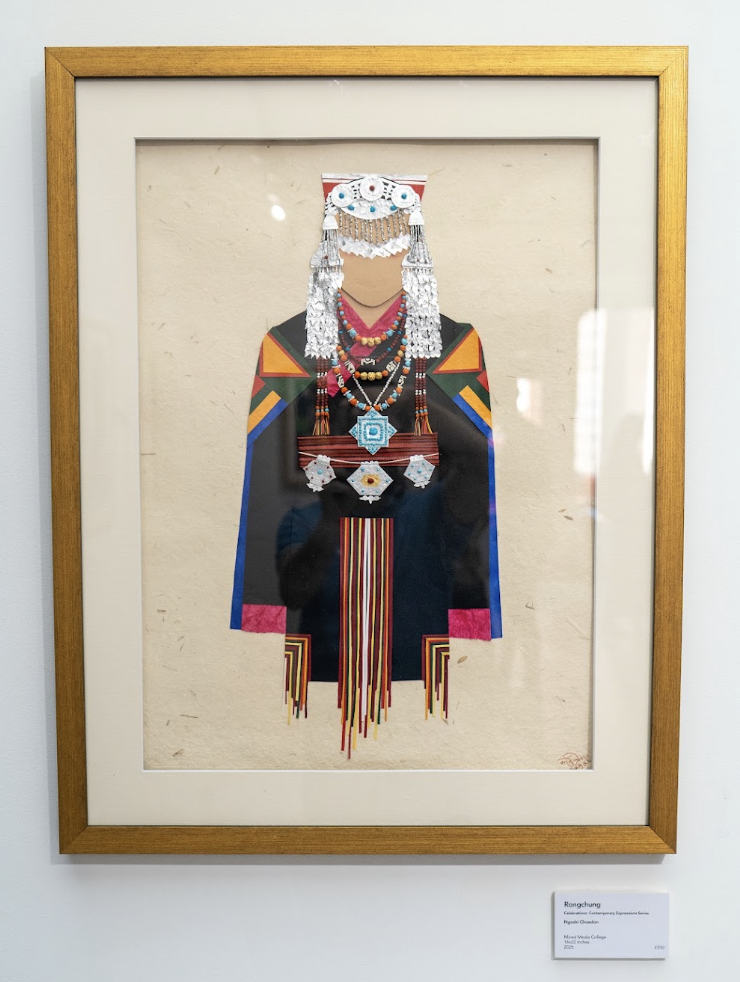
Choedon’s artwork is inspired by different regions of Tibet, photographs, her own experiences, as well as compassion and action. A Quiet Negotiation encompasses two series of artworks: Celebration and Layers of Identity, both tightly connected to the artist’s Tibetan background as well as her own distinct experiences. “Tibetans have a lot of things to fight for,” she said, and her love for the country gave her the power to work on and ultimately present the Celebration series. Artworks from this series distinguish themselves by focusing primarily on the accuracy of the traditional clothing of different regions of Tibet. As the artist notes, the figures wearing the garments do not possess eyes in order for the viewer to better immerse themselves in their story and imagine themselves as part of the culture.
The Layers of Identity series also refers to the Tibetan heritage of the artist, depicting traditional clothing. However, the materials used in the creation of these artworks also refers to the artist’s mixed background, shaped by growing up in exile in India. The works depict Tibetan women dressed in traditional clothing, which is constructed from different scraps of paper and other upcycled materials from across India, the US, and Japan. The mix of international scrap paper with Tibetan spirit and cultural imagery exposes a clash which, combined with the expressive faces of the depicted women, tells both the personal story of the artist and the broader story of Tibetan culture.
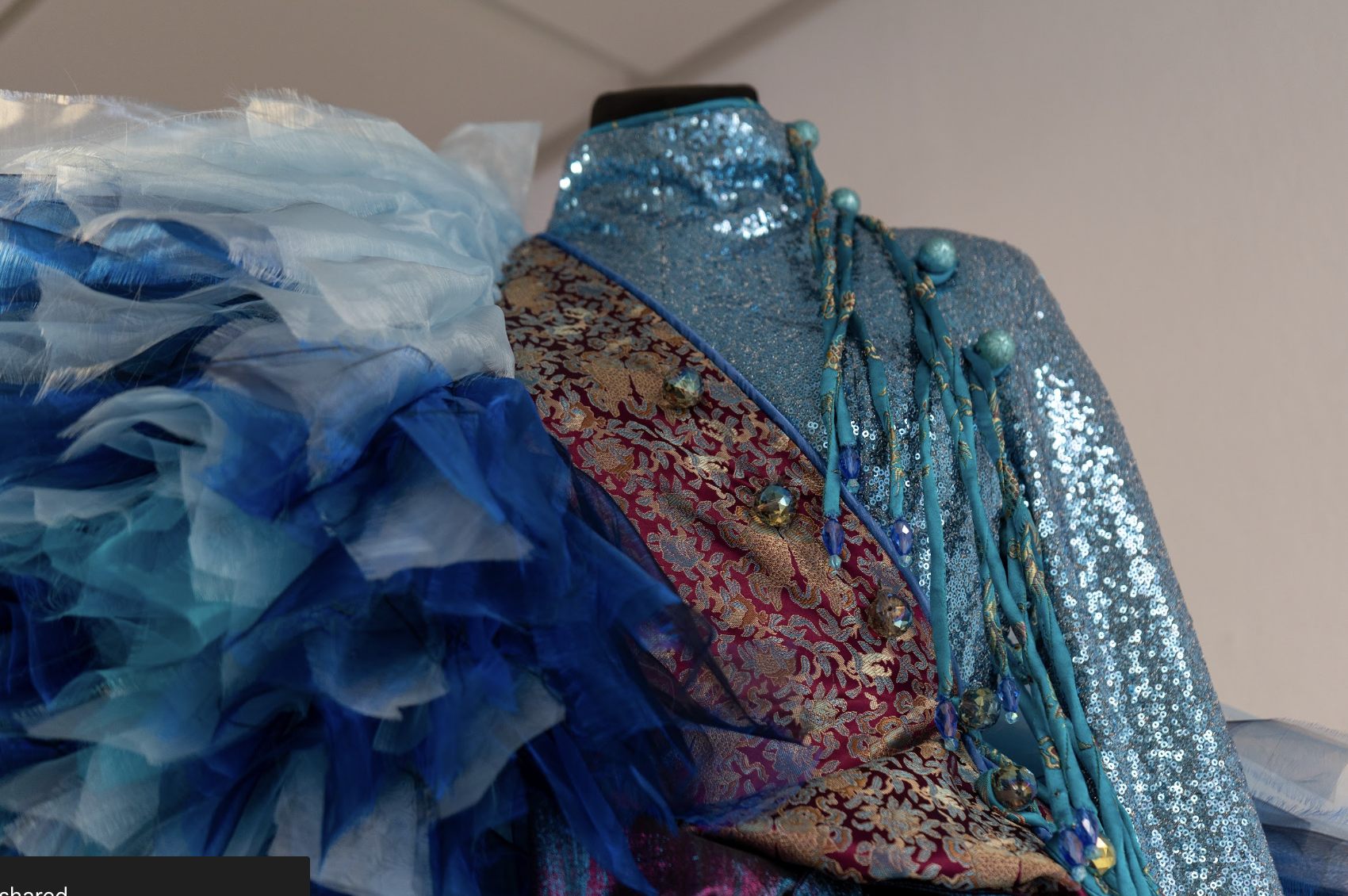
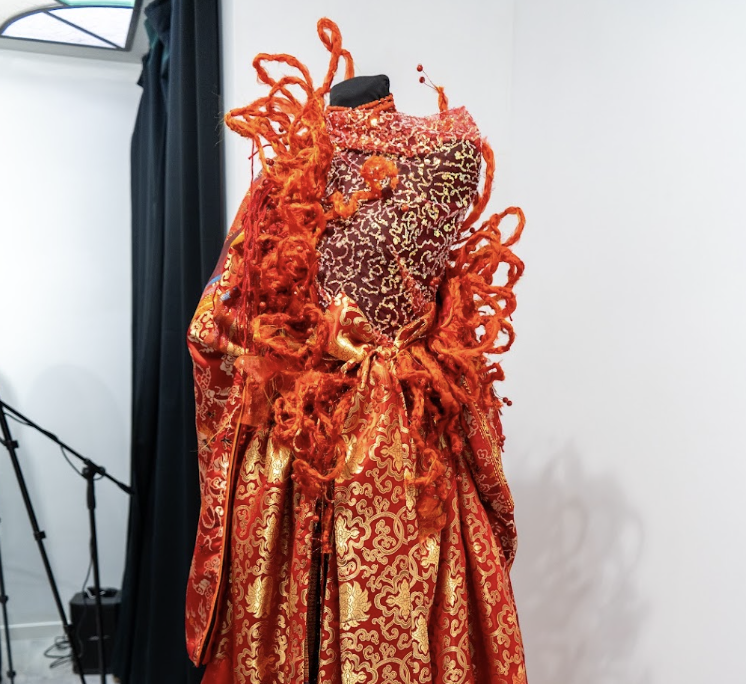
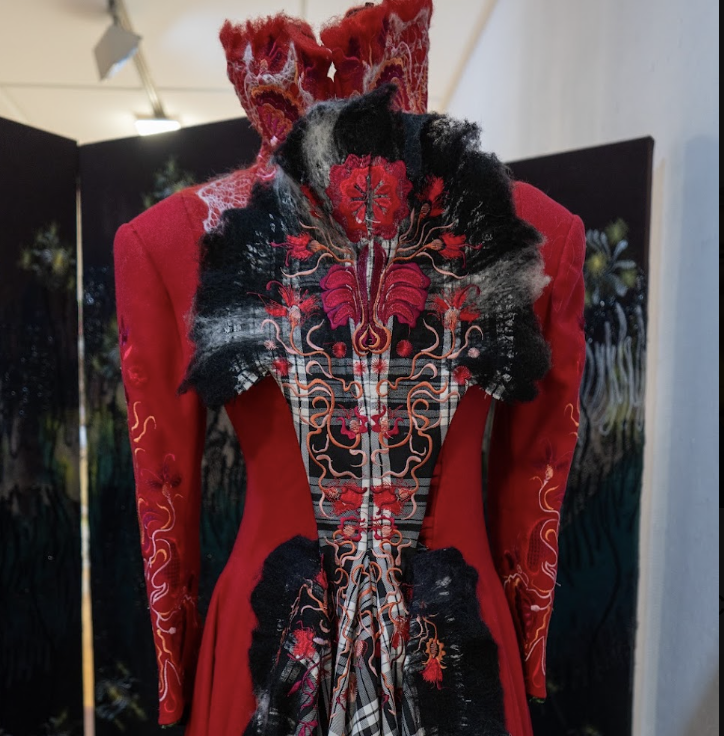
Peter George d'Angelino Tap's contribution to AGAINSAW, entitled Filamentary Residues, is a series of five sculptural garments based on the Tibetan conceptions of water, earth, fire, air and space, while exploring clothing as the result of continuous movement between cultures, histories and ways of making. Through his Sartorial Statues - wearable soft sculptures - garments become more than objects of fashion, as they reveal how traditions are constantly shaped through exchange, adaptation and reinterpretation. Rather than seeing clothing as something fixed or belonging exclusively to one culture, d'Angelino Tap in fact presents it as a living archive, carrying traces of countless encounters across time and geography. "For over forty years I've studied clothing," he explains. "That's what fashion is built on."
Having previously created collections inspired by the Tang Dynasty, called Ephemeral Remnants, Peter George explains that what we often perceive as distinct national dress, is in reality the result of centuries of exchange. For example, Japanese kimono, Tibetan garments and Chinese robes all share historical connections, and as he explains "Everything becomes inspiration for other people."
The title Filamentary Residues reflects this idea. The title refers to the textile filaments, cultural influences and historical residues that accumulate over time before being created into something entirely new, connecting it back to Tibet and to Ngoshi Choedon's layered paper collages. Peter George translated this principle into his own artistic language by combining a wide range of contrasting textiles and textures. "I took a whole lot of materials that also made me think of Tibet," he says. "And I joined them all together so no one piece is made of one sort of material. Everything is mixed up and mashed up."
As previously mentioned, an important conceptual framework for the series became the Tibetan understanding of the five elements: earth, water, fire, air and space. While studying for the project, what began as an intention to create three sculptures, quickly changed when he realised the philosophical system revolves around five interconnected elements instead. Each sculpture responds to one of these elements through colour, material and form. During his research, he became particularly fascinated by the symbolic colours associated with each element, which often differ strikingly from Western conventions. "Water is green," he notes, "From a Western perspective we see it as blue… but they see it as green, which is interesting.” These symbolic colours became an important guide throughout the series. Water is rendered through pools of green, earth is depicted in yellow instead of brown, fire retains its familiar red, while air is represented in white, and space is blue. Reflecting on the process, d'Angelino Tap describes the project as "a learning curve," as he puts it, "no matter how old you are, you can always learn."
Despite the historical and political dimensions that inevitably accompanies this exhibition, Peter George resists positioning the work as explicit activism. Instead, he speaks about beauty as a way of opening conversations. "I'm not Don Quixote" he says. "If you work in this field for so long, you don't think you can change the world any longer, you just try to make beauty." Nevertheless, if Filamentary Residues encourages audiences to recognise Tibet as a country with its own identity, history, culture and artistic traditions, while appreciating the ways cultures continuously shape one another, then the sartorial sculptures have fulfilled their purpose.
The two artists invite us to consider the invisible weight woven into every garment—the memories it shelters, the identities it carries, and the histories stitched into its seams. Bringing Tibetan and Dutch perspectives into conversation, A Quiet Negotiation and Filamentary Residues reveal clothing as a living archive, where tradition is neither frozen nor lost, but continually rethreaded through encounters across time and place. Rather than preserving culture in stillness, the works suggest that heritage remains alive only as long as it is worn, touched, and reimagined.